Goblins Wood: Ide Lumber Sim
- 4.5
- Rating
- 1.00M
- Installs
- Free
- Price
 Analysis by App-foxy
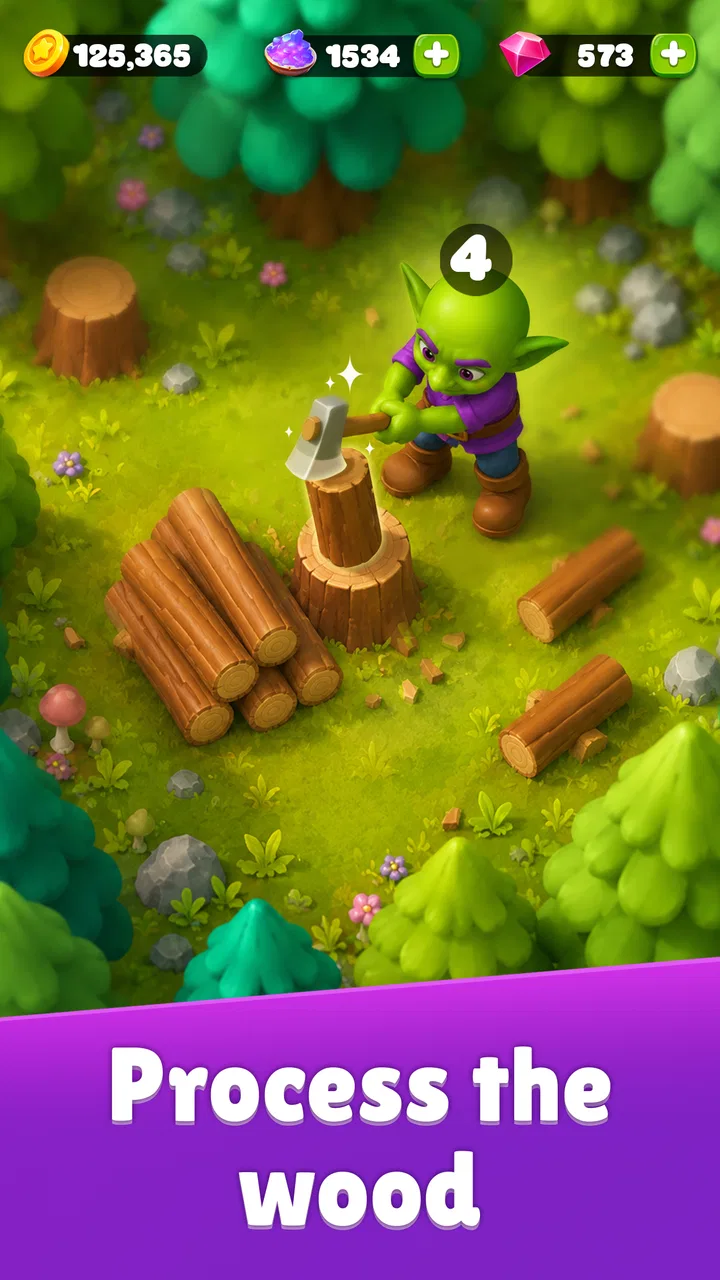
I spent time with Goblins Wood: Ide Lumber Sim as a casual simulation game, and my first impression was that it is built for short, repeatable sessions rather than one long, uninterrupted campaign. Its basic appeal comes from combining goblins, merging, puzzle solving, and the steady feeling of building something larger from small pieces. That gives it a more active rhythm than a simple idle title, while keeping the controls approachable enough for relaxed play.
The game is free to download, belongs to the simulation category, and is made by ProGamesLab. It is rated for Everyone, which matches the lighthearted presentation and easy-to-understand premise. The audience is already substantial, with over one million installs, a 4.5 average from around 164 thousand ratings, and roughly 3.4 thousand written reviews. Those figures suggest that the concept has found a broad audience, but they do not remove the need to look closely at how it feels during ordinary use.
How Goblins Wood feels during everyday play
I find the everyday rhythm easiest to enjoy when I treat each visit as a small, focused task instead of trying to clear every available action. That leaves room to notice which merges genuinely support the next goal and which can wait. From there, the useful question is how to make the first few minutes feel orderly, especially if you are opening the game for the first time.
You May Also Like

 Blood Strike: 2.5 Anniversary
Blood Strike’s Loadouts Turn Every Drop Into a Tactical Gamble
A close look at Blood Strike’s custom loadouts: how fast access to signature weapons reshapes its battle royale rhythm, rewards preparation, and narrows the gap between fights.

 Pandora - Music & Podcasts
Pandora’s Music Is Easy to Start, but Harder to Recover
Pandora’s strength is its low-effort path from a seed to a station. Its weak spot is how much confidence it asks you to place in connection, setup, and quiet recovery.

 8 Ball Pool
 Is Built on Rivalries, Rematches, and Routine
A close look at the rivalries, rematches, shared routines, and unanswered safety questions that turn a quick pool match into a persistent mobile community.

 Samsung Music
’s Quiet Strength Is Playing What You Already Own
Its reach comes less from spectacle than from dependable access to a personal library. That simplicity is both the app’s strongest retention engine and its ceiling.

 AccuWeather: Weather Radar
AccuWeather Review: A Quick, Clear Forecast for Everyday Decisions
For everyday plans, the best forecast is the one you can understand quickly. AccuWeather makes rain timing, radar, and local conditions easy to act on, with a few trade-offs.

 Hill Climb Racing
Why Hill Climb Racing Still Turns Crashes Into One More Run
A tiny car, a bumpy hill and one more upgrade: Hill Climb Racing keeps resurfacing because its simple chaos makes every near-miss feel personal.
More From Our News Desk



A quick start that suits short sessions
The strongest part of the experience is its low barrier to entry. I can open the game, make a few decisions, combine available pieces, and feel that I have moved the settlement forward without first studying a complicated rulebook. That matters for a mobile simulation game because the best time to play is often not a planned gaming session. It may be while waiting for an appointment, taking a short break, or winding down before sleep.
The merge element gives those small sessions a clear purpose. Instead of simply watching a timer, I have something to inspect and arrange. The puzzle layer also helps break up the more passive parts of the progression. In practice, this makes the game feel more involved than a traditional clicker, although players who want constant action may still find its pace measured.
One useful way to approach it is to treat each visit as a small planning exercise. I do not rush to combine everything immediately. I first look at what is available, consider which merge will open the most useful next step, and then spend the remaining actions on progress that supports the current objective. That habit reduces the feeling of randomly tapping through a board and makes the limited time of a short session feel more productive.
Why the pace can feel slower than expected
The word “clicker” may lead some players to expect nonstop tapping and rapid rewards. Goblins Wood is better understood as a hybrid: it has the satisfying accumulation associated with idle games, but it also asks for attention through merging and puzzles. The result is calmer than an arcade game and more interactive than a background-only simulator.
That balance will suit players who enjoy watching a small settlement develop over time. It may frustrate anyone looking for immediate visual spectacle or a constant stream of new mechanics. When progress slows, the game’s appeal depends on whether you enjoy optimizing modest improvements. I found that the experience works best when I accepted the gradual pace instead of treating every pause as something that needed to be overcome.
There is also a practical advantage to this slower structure: it is easier to stop and resume without feeling that I have missed a critical moment. That makes the game a reasonable companion for fragmented free time. It is less suitable for a player who wants a focused challenge with a definite beginning and end in every session.
What happens when the board or progression becomes busy
The heaviest moments are likely to come when several activities overlap: managing merges, checking puzzle goals, collecting progress, and deciding what deserves attention next. Even without turning the game into a technical benchmark, that is the point where a simple idle loop becomes a more demanding management task. My advice is to avoid making every available action at once. A little order goes a long way.
I found it helpful to separate decisions into two groups. First, I look for combinations that directly support the current goal. After that, I deal with less urgent merges and collection tasks. This keeps the screen from becoming mentally cluttered and prevents a useful item from being consumed simply because it was available. The approach is especially valuable during longer sessions, when the temptation to tap quickly can lead to inefficient choices.
The game’s resource demands should also be considered in this context. A simulation built around repeated visual updates, animated characters, and interactive boards can feel more demanding during extended play than during a brief check-in. I would not assume that every phone will behave identically, particularly when other applications are active. Closing unused apps before a longer session is a sensible precaution, especially on older hardware.
Stability and the question of recovery
For me, reliability in a game like this is not only about whether it opens. It is also about whether progress feels safe when I leave and return, whether the interface remains understandable after an interruption, and whether a short session can be resumed without unnecessary friction. Goblins Wood benefits from its compact, repeatable structure because it does not demand that every visit become a major commitment.
Still, players should approach any progression game with sensible habits. If I am about to close the app after a productive session, I prefer to finish the current interaction rather than exit in the middle of a merge or reward sequence. That is not a claim about a particular failure system; it is simply good practice for any mobile game where progress accumulates over time.
Another useful habit is to keep the application updated. The current version is 2.67.1, and using the latest available build is generally the best way to avoid problems that may have been addressed since an earlier installation. The game supports Android 8.0 and later, so compatibility is broad enough for many devices, but an older operating system does not automatically mean identical performance across all phones.
If the game ever feels slow after a long play session, I would first try the ordinary recovery steps: leave the app, clear some background activity, and reopen it. I would also avoid repeatedly tapping while waiting for a screen to respond, since rapid input can make it harder to tell whether an action has registered. These are simple steps, but they are particularly useful in a game where several small actions can affect the next decision.
Device limitations matter more during long sessions
Goblins Wood is a better match for a reasonably maintained phone than for a device already struggling with storage, heat, or background load. The game is not something I would choose as a test of premium hardware, but its ongoing simulation and visual activity still make the condition of the phone relevant. A clean, responsive device should provide a more comfortable experience than one with little free space and many applications competing for memory.
Battery expectations should be realistic too. Short visits are naturally easier on a phone than extended sessions filled with repeated interactions. If I want to play for a long time, I would lower other demands on the device and avoid doing so while the phone is already warm. The important point is not that the game is automatically heavy, but that sustained use always exposes device limitations more clearly than a quick login.
The Android requirement also helps define the audience. Owners of newer or moderately recent phones should have a straightforward starting point, while anyone using a very old handset should pay closer attention to responsiveness and available storage. The Everyone age rating makes it accessible from a content perspective, but age suitability and technical comfort are separate questions.
Free entry, optional spending, and sensible boundaries
The free-to-play structure makes it easy to try the game before deciding whether its loop suits you. That is important here because the central question is not whether the concept sounds appealing; it is whether you enjoy the repeated cycle of merging, solving, collecting, and gradually expanding. I would recommend playing without spending anything at first and learning how the progression feels under normal conditions.
In-app purchases range from $0.99 to $249.99 per item. That wide range is worth taking seriously, even for a game that costs nothing to start. I would set a personal spending limit before buying anything, particularly if the game becomes part of a daily routine. The safest approach is to treat purchases as optional convenience rather than as a requirement for understanding the game.
There is also a strategic reason to wait. Early enthusiasm can make any boost look more valuable than it really is, especially when the next goal is visible and close. After a few sessions, I have a clearer sense of whether a purchase would improve my enjoyment or merely shorten a waiting period. Players who dislike free-to-play economies may prefer a paid simulation with a fixed price and no optional item store, even if that alternative offers less of Goblins Wood’s merge-focused identity.
How it compares with familiar simulation alternatives
Compared with a classic city-building simulator, Goblins Wood feels more compact and puzzle-driven. A traditional builder may offer broader construction choices, longer-term planning, and a stronger sense of designing a complete town. Here, the merge and goblin elements put more attention on immediate combinations and incremental rewards. I would choose Goblins Wood when I want a lighter management experience rather than a detailed architectural sandbox.
Against a pure idle game, it has more for me to do. A standard idle title can be ideal when I want to check progress and leave, but it may become passive. Goblins Wood adds decisions to that routine, which makes each visit more engaging. The trade-off is that it asks for more attention and may feel less relaxing to someone who specifically wants a game that plays almost entirely in the background.
It also differs from a dedicated match or merge puzzle game. Those games usually make the puzzle itself the main event, while this one connects puzzle decisions to a wider simulation loop. That connection gives merges a larger purpose, but it may also mean that players seeking tightly designed standalone levels will find the broader progression less focused.
Small techniques that improve the experience
My first practical tip is to identify the immediate objective before spending resources. A merge that looks attractive in isolation may be less useful than one that advances the current task. This simple pause turns the board from a collection of tempting actions into a set of choices with different consequences.
Second, I would avoid filling every available space or using every item just because the game allows it. Keeping a little flexibility makes it easier to respond when a puzzle asks for something specific. This is one of the less obvious trade-offs in a merge-based simulation: constant activity can feel productive while quietly reducing future options.
Third, I recommend using short sessions to prepare for longer ones. During a quick visit, I can collect what is ready, organize the board, and leave the more complicated decisions for a time when I am not distracted. That workflow is more comfortable than trying to solve every puzzle while commuting or multitasking.
Finally, I would separate enjoyment from efficiency. It is possible to optimize every move, but doing so can make a casual game feel like unpaid administration. The best balance is to make deliberate choices when the board is crowded and play instinctively when the stakes are low. That keeps the goblin theme and puzzle loop enjoyable instead of turning them into a spreadsheet.
Who should install it, and who should skip it
I think Goblins Wood is a good fit for players who like gentle progression, merge mechanics, and simulation games that can be visited several times throughout the day. It is especially suitable for someone who wants more interaction than a passive idle game but less complexity than a full city-management title. The Everyone rating also makes it approachable for a broad audience, assuming the player is comfortable with optional purchases.
I would be more cautious recommending it to people who dislike waiting, recurring progression loops, or free-to-play monetization. Players who expect a complete premium game with no purchase prompts may be happier elsewhere. Likewise, anyone searching for fast reflex challenges, deep competitive systems, or a highly detailed building simulator should look at alternatives designed around those priorities.
It is also not my first choice for a phone that is already near its limits. The minimum operating-system requirement is Android 8.0, but meeting that requirement alone does not guarantee a perfectly smooth experience on every compatible device. A newer, well-maintained phone should make the game more comfortable, while an aging device may turn longer sessions into a test of patience.
My performance verdict after using it
Goblins Wood works because its different parts support one another. The goblin setting gives the simulation personality, merging provides hands-on decisions, and the puzzle structure prevents the experience from becoming a sequence of empty taps. I appreciate that I can make progress in a few minutes, yet still find enough planning to justify a longer session when I have time.
Its limitations are just as clear. The pace is gradual, the free-to-play model deserves careful spending boundaries, and the most satisfying progress comes from accepting repetition rather than expecting constant novelty. Device condition matters more during extended play, and the game is not the right substitute for a deep builder or a pure puzzle title.
Overall, I would recommend it to a friend who wants a friendly simulation game for flexible, low-pressure sessions. I would suggest starting free, learning the merge rhythm, and paying attention to how the game behaves on the specific phone being used. The best reason to try it is the combination of light management and purposeful merging, not the promise of nonstop action. If that slower, incremental style sounds appealing, ProGamesLab’s game is easy to settle into and offers enough structure to keep short visits meaningful.
FAQs for Goblins Wood: Ide Lumber Sim
01What is Goblins Wood: Idle Lumber Sim about?
Goblins Wood: Idle Lumber Sim is an idle management game focused on building and expanding a lumber operation run by goblins. You gather wood, improve production buildings, unlock new areas, and use automated workers to keep resources coming in while you are away. The game combines resource management, gradual upgrades, and light strategy, making it suitable for players who enjoy relaxed progression rather than fast-paced action.
02Can I play Goblins Wood: Idle Lumber Sim offline?
The game may allow some parts of the lumber operation to continue without an active internet connection, especially basic resource production and previously unlocked systems. However, online access can still be required for advertisements, cloud saving, updates, events, purchases, or account-related features. Before relying on offline play, it is worth checking the current store description and testing the game after disabling your connection, since offline functionality can change between versions.
03Is Goblins Wood: Idle Lumber Sim free to download and play?
Goblins Wood: Idle Lumber Sim is generally available as a free download, but the free experience may include optional advertisements and in-app purchases. These purchases can sometimes provide premium currency, speed up construction, remove advertising, or offer additional rewards. You can usually progress without spending money, although upgrades may take longer. Players who prefer completely uninterrupted gameplay should review the purchase and advertising details before downloading.
04Does Goblins Wood: Idle Lumber Sim require a powerful Android or iPhone?
The game is designed as a relatively lightweight idle simulation, so it should run on many recent Android and iOS devices without requiring flagship hardware. Performance can still depend on the phone’s operating system, available storage, memory, and background activity. Older devices may experience slower loading, increased battery use, or occasional stuttering when the settlement becomes larger. Keeping the app and operating system updated can help maintain smoother performance.
05What makes Goblins Wood: Idle Lumber Sim worth trying?
The main appeal is its simple combination of idle rewards and settlement management. You can organize production, invest resources in upgrades, unlock additional content, and watch the goblin-run operation grow without needing to play constantly. It is a good choice for users who enjoy incremental progress, short play sessions, and relaxing management mechanics. However, players seeking deep simulation systems, competitive multiplayer, or intense action may find the experience fairly casual and repetitive over time.
Pros
- Relaxing idle gameplay that works well for short
- casual sessions.
- Simple controls make the lumber operation easy to manage on mobile.
- Steady progression gives you useful goals even when playing passively.
- Charming woodland theme creates a pleasant atmosphere.
- Upgrade choices add some strategy to resource and worker management.
Cons
- Progress can slow noticeably once early upgrades become expensive.
- The idle mechanics may feel repetitive after extended play.
- Some features depend heavily on waiting or returning later.
- Limited strategic depth may disappoint experienced simulation players.
- Frequent promotional prompts can interrupt the otherwise calm experience.

Goblins Wood: Ide Lumber Sim
Gallery